The Fortune-Telling Deck Hiding in a Museum Archive
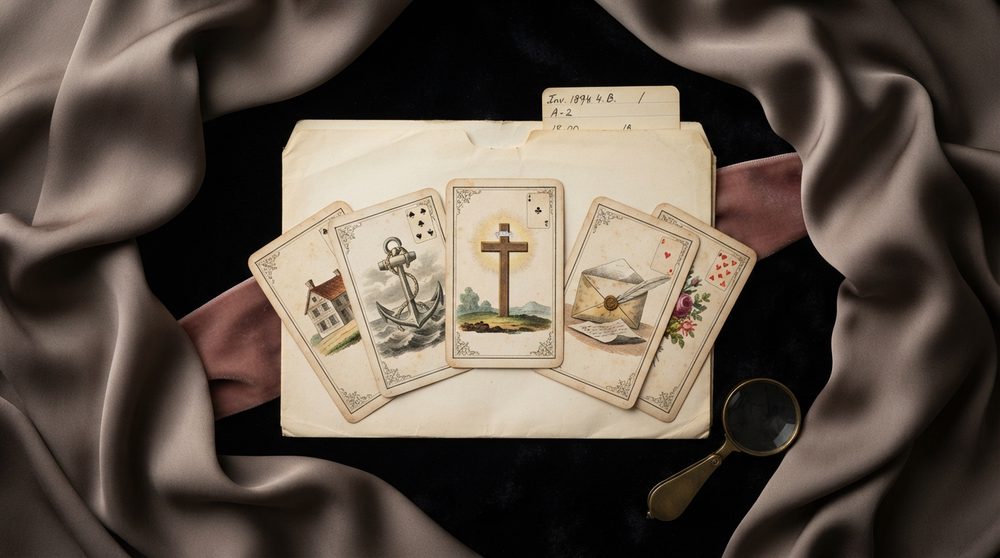
The most coveted card in the British Museum’s Game of Hope isn’t the Sun or the Key. It’s the Anchor. Come to rest on it the right way and you win the pot. Go a single space too far and you’ll find yourself at the Cross, waiting for somebody else to take your place or for the dice to get you out. If you read Lenormand, you’ll recognise the pictures. It’s what they make you do that comes as a surprise.
The museum’s pack is a Nuremberg edition of the game associated with Johann Kaspar Hechtel. It has thirty-six small, hand-coloured cards in a pale blue case and a leaflet with the rules. It came to the museum through the collection of Lady Charlotte Schreiber. In the online catalogue the title is Das Spiel der Hofnung, with the spelling on the box. You won’t find Marie Anne Lenormand’s name on that label. The game supplies the image sequence we recognise, while the famous French fortune-teller’s name belongs to the later story of how the cards were sold and read.
Five cards that give the game away
- Ship, 3: Land here and the Ship carries you to the Birds at 12. The rules send you to the Canary Islands. A modern reader can make a metaphor out of Ship, but here the voyage is an instruction: pick up your piece and actually move it.
- Birds, 12: Their role in that little excursion is to be waiting at the destination. Notice how different that is from drawing Birds in a modern line and immediately hearing chatter. Look at what the image is doing in the game before you ask what it might mean in a reading.
- Letter, 27: You have received a letter. You also owe two marks to the bearer. That small piece of business makes the illustration feel lived-in: written news is not just an abstract message, but something that someone has had to carry to you.
- Anchor, 35: Reach it by moving forward and the money is yours. Coming back onto it after overshooting doesn’t count. If you only know the modern Anchor as stability or endurance, consider what hope looks like when the game gives it the force of an ending.
- Cross, 36: A player one step past the prize has to wait for a double or for someone else to land there and take over the burden. You don’t need a list of keywords to understand why this would be an exasperating card to see near the end of a game.
The other thing the leaflet tells you to do
The game calls for an ordered square of six cards by six. The fortune-telling instructions do something different: shuffle, let the sitter cut, lay out four rows of eight with four cards underneath, and tell a playful story from the pictures near the person card. There is no need to read modern houses, mirrors or sight lines into that instruction. The important thing is that the same little pack can be a board in one arrangement and a story in another.
Try placing Anchor and Cross beside each other and looking at them first without consulting your guidebook. Read them once as a player approaching the end of the board, and again as a practitioner considering a commitment with a difficult limit. The second reading doesn’t have to reproduce the first. But after you have watched the Anchor win and the Cross stop play, it is harder to see either as just a word on a list.