Why direction changes meaning: reading the Grand Tableau by sight lines
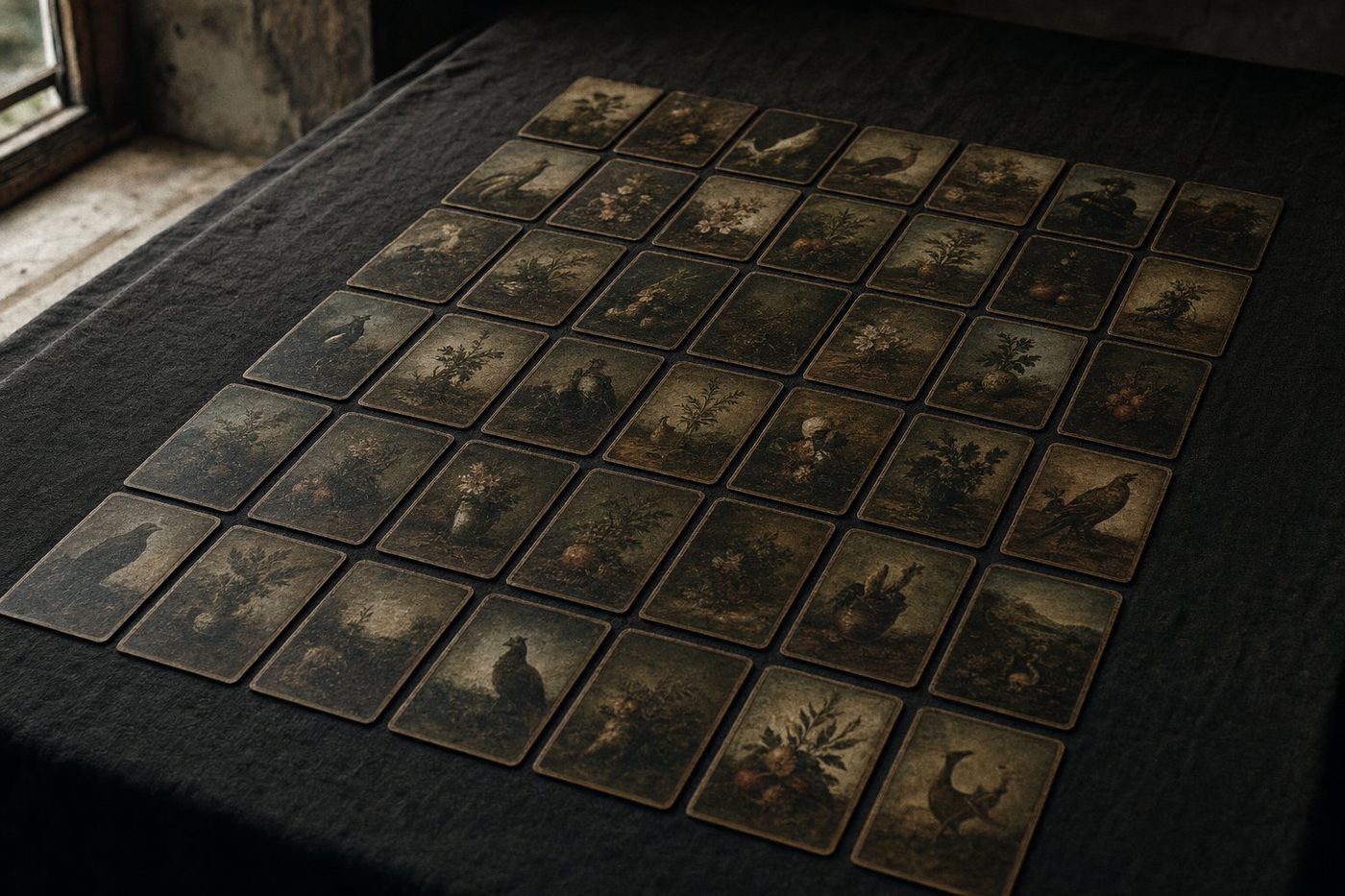
The most common way to fail at the Grand Tableau is to read it as thirty-six small readings. A practitioner deals the full deck, finds the significator, and then works outward card by card, producing a list of statements that are individually defensible and collectively meaningless. The problem is not the cards. It is that the tableau is a single document with a spatial grammar, and card-by-card reading discards the grammar entirely.
What position actually contributes
In a three-card line, position is doing modest work: cause, subject, outcome. In a tableau, position carries two independent burdens at once. The first is the house: under the standard numbering, the cell in position 12 carries the significance of card 12, so a card falling there is being read through that house’s subject. The second is relation — what the card sits beside, above, below, and diagonally from.
These two burdens can disagree, and the disagreement is informative rather than a fault. A card of movement sitting in a house of stasis is not a contradiction to be resolved by picking one; it is a statement about a specific tension in the matter. Readers who insist on a single meaning per cell lose exactly the information that makes the tableau worth laying out.
Direction is the third contribution and the one most often dropped. In the CultIndies reference deck, each of the thirty-six cards has a recorded facing: the side toward which the principal figure or its motion is oriented. Facing is read relative to the board, not to the card. A card facing right is oriented toward the cards later in its row; a card facing left looks back at what precedes it.
A card facing away from the significator describes something leaving. The same card, facing toward it, describes something arriving. Nothing about the card has changed except which way it looks.
That is not a decorative refinement. It is the difference between a reading that says news is coming and one that says the news has already gone past you.
The five passes
The method below treats the tableau as a document to be read five times, each pass extracting one class of information. Each pass is complete before the next begins. Notes are written down; the point of the sequence is that later passes correct earlier ones, which is impossible if the earlier ones were never fixed in writing.
Pass one: rows
Read each row left to right as a temporal line. Rows in a 9 × 4 tableau are the closest thing the layout has to narrative: they carry sequence. Note where a row changes character partway along, and note which cards face against the direction of travel — those are the points where the sequence stalls or reverses.
Pass two: columns
Read each column top to bottom as a simultaneous condition rather than a sequence. Columns describe what is stacked in one area of the matter: the surface, the working level, and what sits underneath. A column that is uniform is telling you the area is settled; a column that alternates is telling you it is contested.
Pass three: diagonals
Diagonals connect the significator to cards it does not touch in row or column. Read only the two diagonals through the significator on this pass, and read them as influences that reach the subject indirectly — through third parties, institutions, or circumstance rather than through the querent’s own action.
Pass four: knighting
Knighting takes the chess knight’s move from the significator and reads the cards it lands on. Traditionally these are read as hidden or displaced influences. Treat them with restraint: the technique generates up to eight additional cards, and a reader determined to find significance will find it. Knighting is most useful as a check — if a knighted card repeats a theme already established in passes one to three, that theme is load-bearing. If it appears nowhere else, leave it out.
Pass five: mirroring
Finally, read the tableau as a mirrored field: the card equidistant from the significator on the opposite side, and the corresponding cells at the four corners. Mirroring answers a specific question — what is the counterpart of this influence? It is the pass that most often reveals that two apparently separate strands of the reading are the same strand seen from two ends.
Where the method comes from, and where it is modern
Honesty about provenance matters here. The house system and the significator convention are documented in nineteenth-century instruction sheets and in the German-language literature that follows them. The five-pass sequence as set out above is a modern teaching structure — our own — imposed on techniques of varying age. Rows and columns are old. Knighting and mirroring are attested later and less consistently, and are treated in this article as auxiliary for that reason.
The claim being made is not historical but practical: a tableau read in fixed passes produces a reading a practitioner can reconstruct a week later, and a tableau read card by card does not. Reproducibility is the standard we hold the method to.
A worked constraint
Impose one rule when practising: no interpretive statement may be made until the pass that generates it is complete. Readers find this uncomfortable, because the significator’s immediate neighbours are so suggestive that the temptation to conclude is immediate. That temptation is precisely what the sequence exists to interrupt. The neighbours of the significator are one datum among five classes of datum, and they are not privileged.
Keep a log. Record the question, the significator’s cell, then the five pass notes, then the reading. Return to it after the matter has resolved and mark which pass carried the information that turned out to matter. Most readers discover, over twenty or thirty logged tableaux, that they systematically over-weight one pass and ignore another. That correction is worth more than any additional card meaning.
Sources and further reading
The thirty-six card set descends from Das Spiel der Hofnung, the German parlour game published by J. K. Hechtel in Nuremberg in 1799, whose numbered board is the direct ancestor of the house system used above. The attribution of the deck to Marie-Anne Lenormand is posthumous and commercial: she died in 1843, and the decks bearing her name were issued afterwards by publishers who found the association useful. Any account that presents the tableau as her personal method should be treated as marketing rather than history.
For the wider history of how cartomantic rules circulated in print, Michael Dummett and Ronald Decker’s A History of the Occult Tarot is the standard critical account, and a useful corrective to claims of unbroken oral tradition. Primary material is easier to find than most readers assume: the nineteenth-century Dondorf and Wüst deck sheets survive in several museum playing-card collections, and facsimile editions reproduce the printed instruction leaflets alongside the cards.
The facing data referenced above is our own: it is recorded from the CultIndies reference deck and published in the directional facing index, with the convention stated so that it can be checked against another deck rather than taken on trust.