Lenormand decks: traditional cards, extra symbols, and different ways to read
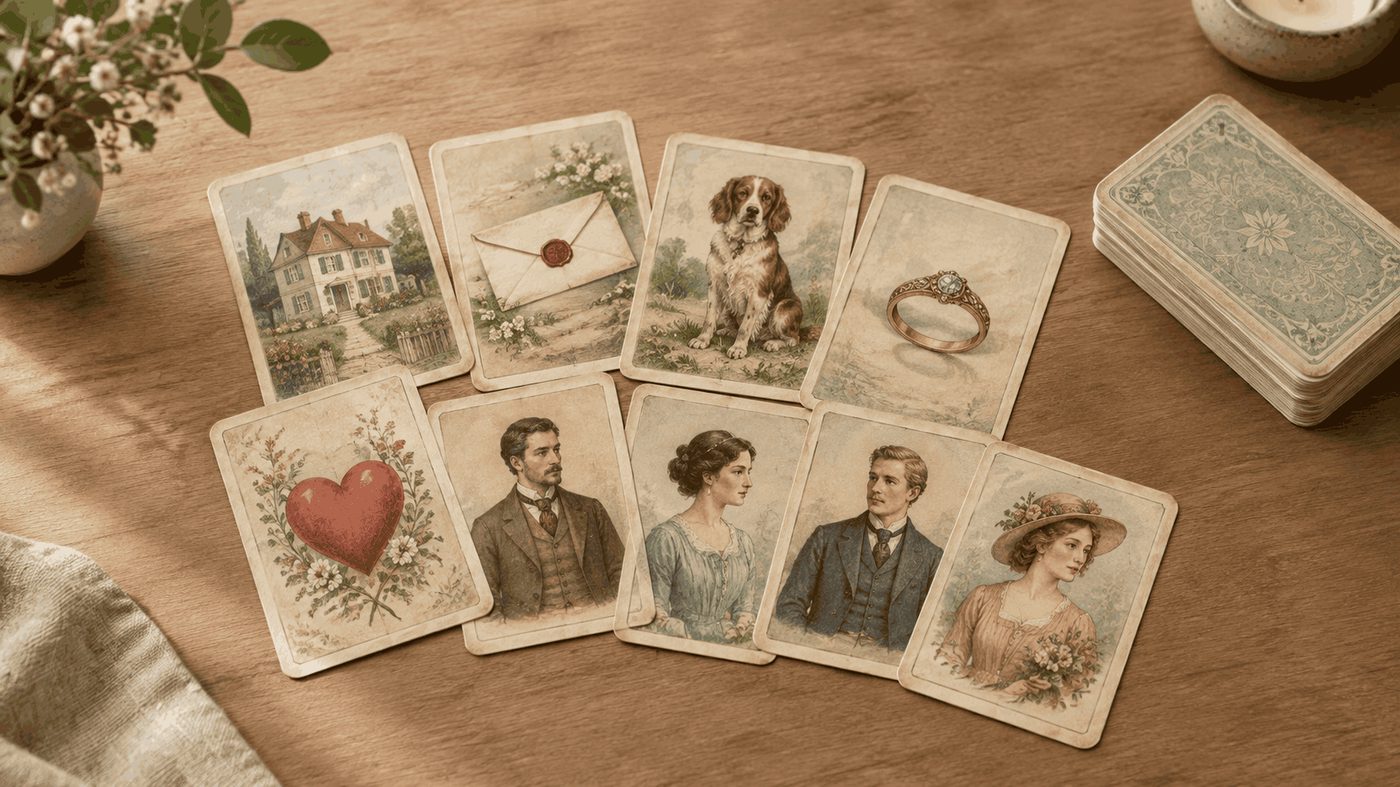
A house, a letter, a dog, a ring. At first glance, a Lenormand deck can look almost too simple. There are just 36 cards in the traditional deck, compared with tarot’s 78, and readers generally don’t assign separate meanings to cards that land upside down. But that small collection of everyday images has plenty to say. The interesting part is how the cards speak to one another.
Lenormand has a reputation for being direct, but if you have claire-sensory abilities, it might not feel that way to you. There’s a way to use Lenormand as a confirmation of what you sense otherwise and it makes total sense that with these abilities, you don’t need the scene spelled out with the whole context on the table. The original creator of this deck, Madame Lenormand, was a seer after all.
Still, where tarot might invite you into the atmosphere of an illustrated scene, Lenormand usually brings you right to the symbol itself and the cards beside it. A card is a word in a sentence: its meaning becomes more specific as the other cards join in.
In my opinion this gives intuition something to work with and it might be a good way to train it, too. If you enjoy noticing connections but also appreciate a little structure, this balance may be part of the appeal.
Also, once you start looking at decks, you’ll find that the Lendormand language comes in quite a few different styles.
The same familiar symbols, a different world
Not every Lenormand variation changes the way you read. Sometimes, it changes the world the cards invite you into.
Celtic Lenormand, by Chloë McCracken and artist Will Worthington, brings nature-based pagan themes into the traditional system. It’s a particular interpretation of Lenormand, rather than a separate set of rules shared by every deck with Celtic imagery.
That distinction is useful when browsing. A theme tells you something about a deck’s atmosphere, but not necessarily its structure.
But to see what you’re actually getting, look for the familiar symbols, check the card count, and find out whether the creator has introduced alternative cards or entirely new ones.
In Brazil, Lenormand has its own familiar presence
In Brazil, Lenormand is widely known as baralho cigano. You’ll find traditional 36-card editions alongside decks with more explicitly spiritual themes, including editions featuring Preto Velho imagery. Lenormand decks are also often sold in shops serving Umbanda and Candomblé communities.
There’s not much need for labels here. A traditional Lenormand deck sold in a religious shop isn’t automatically an orixá oracle, and a spiritually themed deck may have its own approach. I have one deck with orixá inspired imagery and 4 extra cards. It reads similar to the traditional deck but because of the nature of the 4 extras, it’s a bit more suitable for love readings and spiritual questions. It came with a booklet and I can honestly report that the meanings are the same as in the traditional editions, but this particular deck frames them more constructively.
To give you an example, a classic Lenormand deck will tell you that the mountain means an obstacle. Dead simple, and here’s where the reputation for directness comes. On the other hand, the orixá inspired deck that I have says that the mountain is a challenging situation that offers and opportunity for growth and deepening your relationship with your spirit guides.
So, rather than gathering all of these decks under one broad “African-inspired” category, it’s more helpful to look at the individual edition: which figures appear, what tradition the creator names, and whether the guidebook keeps the familiar Lenormand meanings or adds another layer.
That gives the spiritual references the attention they deserve and gives you a much better idea of how the deck will read.
So why do some decks have more than 36 cards?
The traditional deck has 36 cards, but expanded editions don’t share one fixed size. You might come across different totals, so it’s worth checking what those extra cards actually are. Ciro Marchetti’s Gilded Reverie Lenormand Expanded Edition, for instance, contains 47.
Some of its extras are alternative versions of existing cards: another Man, another Woman, and an Owls card. Others introduce new symbols, including Time, Bridges, Dice, Mask, Well, Compass, Labyrinth, and Magnifying Glass.
Those are two quite different kinds of addition. An alternative Woman card might replace the original. A Time card introduces something new to the reading. And buying an expanded deck doesn’t mean you have to shuffle every card into every spread: the Gilded Reverie instructions describe different ways of using its additions.
Think of the extras as options, not homework.
More people cards, more room for real life
Extra person cards are a particularly thoughtful addition. Traditional Lenormand includes a Man and a Woman, but that pair doesn’t represent every relationship or every situation someone might want to explore.
Gilded Reverie’s additional Man and Woman cards can be used for same-sex readings or for situations involving several people. They can also replace the original figures while leaving the deck at its traditional size.
The advantage is refreshingly practical. Two men or two women can each have a person card, rather than requiring another symbol to stand in for one of them. A reading involving several people can also give those individuals a more distinct place on the table.
The important part is deciding who the cards represent before you begin. That way, the extra figures bring clarity rather than a new round of guessing.
What about Time or a card for the Lovers?
Not every extra card represents a person. Some give a familiar idea its own image.
Time is one of Gilded Reverie’s added symbols. It belongs to that expanded edition, however, rather than to the traditional Lenormand sequence. That means its guidebook matters: you’re learning the creator’s addition, not a card that every Lenormand reader will necessarily use.
The same distinction applies to a dedicated Couple or Lovers card. Traditional Lenormand has no equivalent of tarot’s card called The Lovers. Relationships are explored through combinations involving symbols such as the Heart, Ring, Man, and Woman.
An added card can offer another way into a subject. The useful question is whether it gives you a distinction you enjoy working with or simply names something you already read comfortably through combinations.
Don’t overlook the size of the cards
Card size is less glamorous than artwork, but it deserves a place on your checklist. Do you have tiny hands? I do and I appreciate the smaller size of some oracle decks.
Lenormand decks come in different dimensions, usually between 9cm to 11cm on the longer side.
That difference becomes noticeable if you want to try a Grand Tableau, the layout that uses all 36 traditional cards. Smaller cards leave more room on the table; larger ones give the artwork more space but need a larger reading surface. Check the card dimensions, not just the size of the box.
A deck you’ll enjoy getting to know
There’s no need to treat the traditional deck and its variations as competing choices. They offer different pleasures: familiar symbols, a setting you connect with, more flexible person cards, or a handful of new ideas to explore.
What matters is knowing which kind of variation you’re choosing. Look for symbols you can recognize, instructions that explain the additions, and a size that suits the way you want to read.
Lenormand already gets a great deal of variety from a small deck. Its appeal isn’t how much information can fit onto one card, but how much can happen between a few of them.