How to Read the Four Corners of a Lenormand Grand Tableau
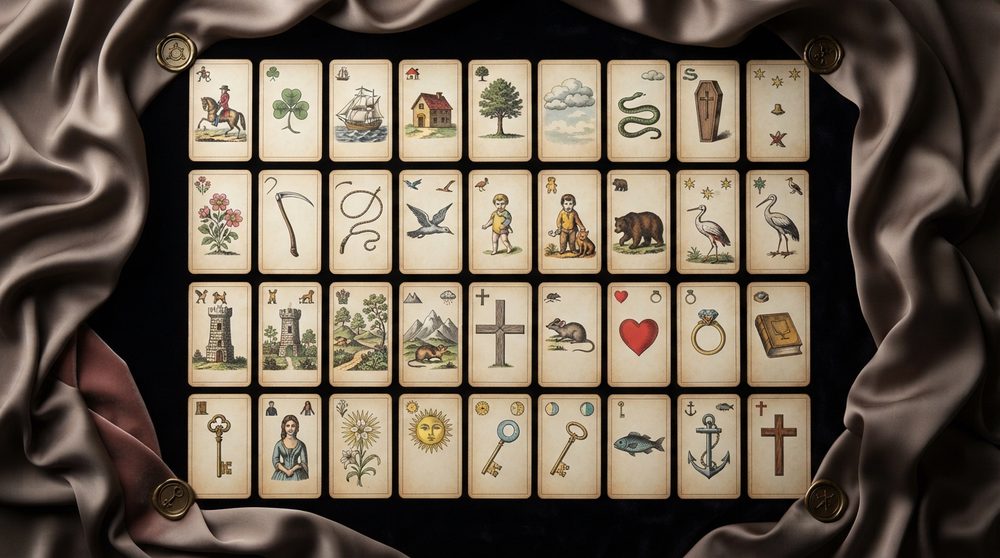
The four corners of a Lenormand Grand Tableau are easy to overlook precisely because nothing is hiding them. The eye finds the person card, gets caught by the cards around it, and starts following diagonals. Meanwhile, four cards sit at the edge of the table, doing something the busy centre cannot: showing you what kind of room the question is in.
That is how I like to read the corners: as the frame around the situation, rather than a miniature prediction. You can glance at them first, but hold off on interpreting them until you have read the part of the tableau that actually addresses the question. Then the corners give you something to compare against, rather than a story you spend the rest of the reading trying to prove.
Find the four corners before you interpret them
In a 9 × 4 deal, they are positions 1, 9, 28 and 36. In an 8 × 4 + 4 deal, be explicit: if you use the four corners of the main rectangle, they are 1, 8, 25 and 32. The four cards below that rectangle belong to a different part of the layout. The example here uses the 9 × 4.
| Row | 1 | 2 | 3 | 4 | 5 | 6 | 7 | 8 | 9 |
|---|---|---|---|---|---|---|---|---|---|
| 1 | House | Rider | Fish | Tree | Birds | Star | Clover | Book | Moon |
| 2 | Bouquet | Ship | Mice | Dog | Garden | Letter | Stork | Clouds | Key |
| 3 | Anchor | Bear | Mountain | Woman | Ring | Sun | Fox | Child | Snake |
| 4 | Tower | Coffin | Cross | Whip | Man | Heart | Lily | Crossroads | Scythe |
Imagine someone considering a monthly reading circle. A friend has offered to help, and there is a choice between hosting privately and approaching a community venue. Near Woman, the Dog, Garden and Ring give us plenty to work with: a friend, a gathering and a commitment. The risk is that we see the event before we see what it will take to keep the event going.
Give the edges different jobs
Read the top edge left to right: House + Moon. In this example, House establishes the subject and Moon qualifies it. You might hear “a familiar place that develops a reputation.” Hosting at home need not mean keeping the circle informal or invisible. You can have a recognisable event with a small guest list.
Read the bottom edge the same way: Tower + Scythe. If the Tower stands for an institution in this question, Scythe makes the arrangement feel conditional: a venue with a hard closing time, a cutoff for booking or little room to negotiate. Resist the urge to tell the sitter the venue will cancel. There is a better question available: which rules would you need in writing before agreeing to run the circle there?
Now compare the sides. House and Tower put a private base next to an institutional one. Moon and Scythe put the wish to be recognised next to the need to draw a firm line. Together, the four corners make it possible to say something more useful than “yes, start a circle”: decide what stays intimate, what becomes public and what you will not commit to yet.
Stop before the frame becomes the picture
You can read the opposite corners as well, but adding every possible pairing makes it easy to find whatever you went looking for. For a practice reading, choose two axes before the deal and write down a single sentence about the frame. Then ask what that sentence adds to the reading you already have.
If the centre says the sitter needs to clarify the collaboration, and the corners help articulate what needs clarifying, they have earned their place. If all they add is a dramatic subplot, leave it at the edge of the table. Not every card that can speak needs the last word.