Lenormand Mirroring vs. Knighting: One Spread, Two Readings
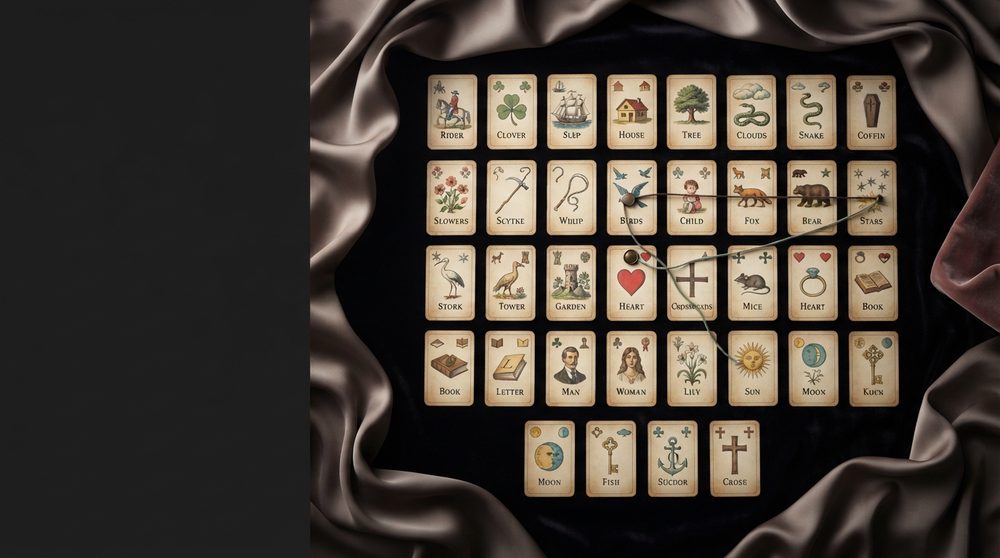
One of the pleasures of the Grand Tableau is the moment when two cards on opposite sides of the spread suddenly have something to say to each other. One of its hazards is that, with enough geometry, you can make that happen to almost any two cards. Mirroring and knighting are worth keeping separate because they ask different questions, even when they are working on the same problem.
A mirror asks, “What is this card’s counterpart?” A knight’s move asks, “What else might be bearing on this card from outside its immediate neighbourhood?” Neither is a reason to skip the neighbours. Both work best when you already know what you are checking.
One friend, one promise and a lot of space
Our sitter is organising a monthly reading circle. A friend has offered to help, but nobody has decided who will handle bookings or reply to people. Start with Dog in the second row, fourth column. Read the adjacent Dog + Garden as a friend helping with a group, and Garden + Letter as written communication for that group. You do not need an advanced move to arrive at either of these.
| Row | 1 | 2 | 3 | 4 | 5 | 6 | 7 | 8 | 9 |
|---|---|---|---|---|---|---|---|---|---|
| 1 | House | Rider (K) | Fish | Tree | Birds | Star (K) | Clover | Book | Moon |
| 2 | Bouquet | Ship | Mice | Dog | Garden | Letter (M) | Stork | Clouds | Key |
| 3 | Anchor | Bear (K) | Mountain | Woman | Ring | Sun (K) | Fox | Child | Snake |
| 4 | Tower | Coffin | Cross (K) | Whip | Man (K) | Heart | Lily | Crossroads | Scythe |
Mirroring: the friend and the inbox
Choose the vertical centre line, which runs through column 5 here. Stay in the same row. Dog is one column left of the line; Letter is one column right. Garden sits on the axis itself. You could choose another axis for another exercise, but don’t silently switch axes when the first pairing is less exciting.
Dog mirrors Letter: friendship and written communication are counterparts in this question. That does not mean the friend has sent a secret message. With Garden sitting between them, the mirror picks out the difference between offering help and making an agreement the group can depend on. A useful next move is to write down who handles bookings before putting either name on the invitation.
Knighting: what makes the help sustainable?
Now start at Dog again and use the chess move: two rows and one column, or two columns and one row. Ignore any landing outside the rectangle. Here the legal landings are Rider and Star above, Bear and Sun below, and Cross and Man two rows down. Letter isn’t one of them.
Cross is worth checking against the rest of the deal. Mice sits next to Dog, and Ring is nearby. Taken together, a small recurring duty draining a friendship is more plausible and more useful than a grand claim that the friend feels burdened. Bear raises a related question about who has authority, but I’d keep it tentative unless the venue or the money has already come up. There is no need to invent a role for Man just because the move reaches it.
Keep the note you could defend tomorrow
The mirror gave us the form of the agreement: put it in writing. The knight highlighted what the agreement should address: the work that repeats after the first meeting. A concise reading can keep both without reporting every card you touched.
This is a good notebook exercise even when the methods don’t agree. Write what you found in the immediate area, what the mirror added, and what the knighted card confirmed. Leave the last line blank if nothing was confirmed. A blank line is more informative than a forced result, especially if you want to understand how you actually read.