The Playing-Card Insets on Lenormand Decks: What Are They For?
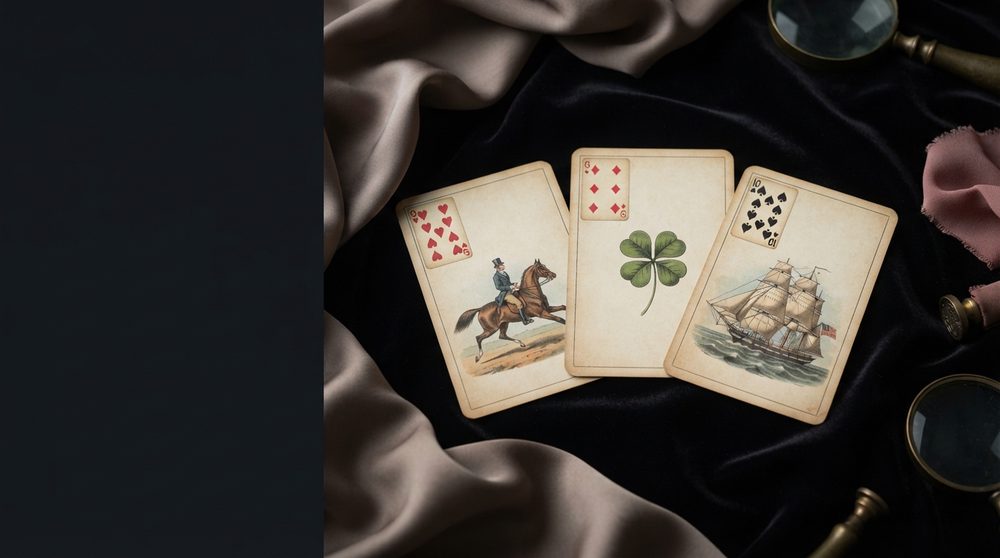
On a Petit Lenormand card, a dog may take up most of the picture while a ten of hearts sits quietly above it. It is an odd piece of design if you have come from Tarot. Is the dog the card? Is the ten of hearts the card? And if both are speaking, which one do you listen to first?
The large image and the small playing card are two ways to identify the same piece of cardboard. You can use both in a reading, but you don’t have to. In practice, the better question is not whether the inset means something. It is whether you have asked it to do a job that the big picture hasn’t already done.
A familiar design with an unfamiliar top half
In The Game of Hope, the German game associated with Johann Kaspar Hechtel that supplied the familiar 36-image sequence, there could be two miniature cards above a single vignette. One used French suit signs and the other gave its German equivalent. Think of them as two labels on the same game piece, not two competing esoteric messages. Hearts and spades will be recognisable to most contemporary readers; leaves and acorns tell you something about the audience for the earlier pack.
Compare that with a traditional Blue Owl Lenormand, where French-suited insets sit alongside the familiar numbered pictures. A Red Owl verse edition gives that space a different job: a short fortune-telling text rather than a miniature playing card. Set the two editions side by side and look for Dog and Letter. The pictures remain readable without any inset, but the edges of the cards invite very different kinds of attention.
When a suit changes what you notice
Suppose you draw Dog + Letter for the question, “How should I follow up with the friend who offered to help?” In the image-led reading, Dog identifies the friend and Letter qualifies how the follow-up should happen. Send a clear message instead of relying on what both of you remember from the conversation.
Now look at the insets: Dog is the ten of hearts; Letter is the seven of spades. Suppose your established playing-card practice uses hearts to notice interpersonal considerations and spades to notice friction. That second pass might bring out the contrast between the warmth of the offer and the awkwardness of putting limits in writing. You might draft a message that begins with a genuine thank-you and then asks a precise question about time. That is a real difference in how the reading is used, without needing to claim that spades reveal what the friend secretly thinks.
The suit emphasis is a chosen example, not an official translation of Dog and Letter. Someone who reads the ranks as well as the suits will need a method for both. Someone using a different cartomancy school may not make the same distinction at all. Write down the system you’re using before you read, especially if it was developed for a different deck.
Leave the inset alone sometimes
Try keeping two columns in your notebook for a week. In the first, record the image reading in one sentence. In the second, give the inset one sentence only if it sharpened or altered something you could name. “It made the message more specific” is a result. “It made the reading seem deeper” isn’t much to work with.
A playing-card inset can be part of a disciplined reading, a beautiful historical detail or something you hardly see. What it shouldn’t become is a reserve pile of meanings to draw from whenever the first reading feels inconvenient.