Mugwort: three centuries of dream work, and what the sources actually say
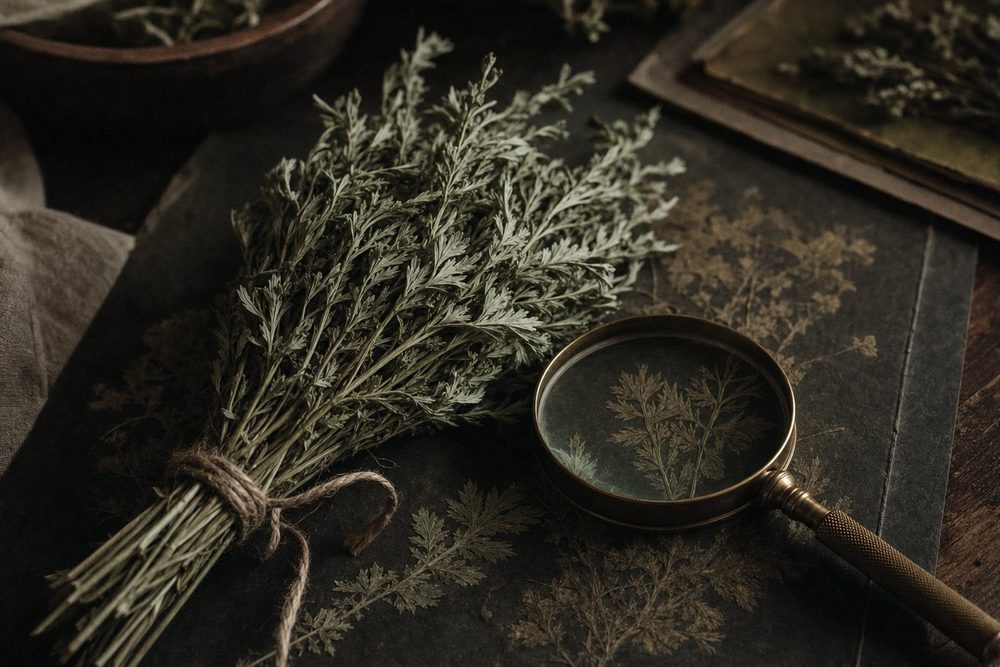
Ask a contemporary practitioner which herb is used for dream work and the answer is almost always mugwort. The association is now so standard that it is repeated without attribution, which is usually a sign that nobody has checked. Having spent some weeks with the herbals, the pharmacopoeias, and the ethnobotanical literature, we can report that the dream reputation of Artemisia vulgaris is genuine, considerably more recent than commonly claimed, and attached to a narrower set of practices than the modern literature implies.
What the older herbals actually attribute to it
The plant is well documented from antiquity onward, but not for dreaming. Dioscorides treats artemisia as a warming, bitter herb for gynaecological complaints and for the retention of urine. Pliny records its use as a footsore remedy for travellers — the tradition, repeated for the next fifteen centuries, that a leaf in the shoe prevents fatigue on a journey.
The English herbal tradition follows the same line. Culpeper, in the seventeenth century, assigns mugwort to Venus and lists it for menstrual obstruction, for the liver, and as a fomentation. Gerard describes the plant carefully and again gives no oneiric use. Maud Grieve, compiling the tradition in 1931, records the traveller’s charm, the bitter tonic use, the substitution for hops in brewing that gives the plant its English name, and the moxa preparation — but dream work appears nowhere in her entry.
That is a striking absence. Four of the most-consulted sources in the European herbal canon describe this plant at length and none of them says it affects dreams.
The dream reputation is not ancient. It is a twentieth-century attribution, and pretending otherwise makes the actual history less interesting than it is.
Where the dream attribution comes from
Three strands appear to converge, and they can be dated.
The first is the moxa connection. Dried and processed Artemisia — usually A. argyi or A. princeps rather than A. vulgaris — is the material of moxibustion in Chinese and Japanese practice, documented in the medical literature for well over a millennium. That association put the genus in front of Western readers in the twentieth century as a plant with genuine, codified therapeutic use, and some of that authority transferred loosely to the European species.
The second is the mid-century revival of Anglo-Saxon material. The Nine Herbs Charm, in the tenth-century Lacnunga, opens by addressing mugwort directly, and the plant is prominent in the Old English Herbarium. The charm is protective and apotropaic rather than dream-related, but its incantatory register made it attractive to twentieth-century revivalists, and the step from protective charm addressed to a plant to plant used for visionary work is short if nobody is checking.
The third and most decisive strand is late twentieth-century Anglophone practice itself. From the 1970s onward, printed and then online compendia list mugwort under dreaming, prophetic sleep, and dream pillows. Each entry cites the previous one. There is nothing dishonest in this — it is how a living folk practice accumulates — but it is a modern tradition roughly fifty years old, not an inherited one.
There is also a fourth, more interesting possibility. The plant is bitter and aromatic, contains thujone, and has a mild but real effect on sleep architecture in some people who drink it as a strong infusion or smoke it. A practice with a noticeable effect can plausibly be discovered independently many times without leaving a paper trail. What we can say is that if that discovery happened before 1900, the herbals did not record it.
What the practice looks like, described honestly
Stripped of the false pedigree, contemporary mugwort dream work is a specific and modest set of methods. A dream pillow of dried aerial parts placed near the head. A weak infusion — a teaspoon of dried herb, water off the boil, five minutes, taken an hour before sleep. Occasionally a wash or a smoke, both of which we would advise against for reasons given below.
Practitioners consistently report the same thing: not more dreams but more recalled dreams, with an unusually vivid or agitated quality. That is a plausible profile for a mildly stimulating bitter aromatic taken before sleep, and it is not a claim requiring three centuries of authority to be worth trying. It is also not universal. A meaningful minority report nothing, and a smaller number report unpleasant, restless sleep and stop.
Preparation notes
Harvest the aerial parts before the plant flowers fully, on a dry day, and dry them out of direct sunlight until the stems snap rather than bend. Strip the leaves from the coarse lower stems, which contribute bitterness without aroma. Store in amber glass away from heat. The herb loses aroma noticeably after about a year, which is a reasonable indicator of when to replace it.
Cautions, which are not optional
This is where a great deal of the popular literature is negligent. Artemisia vulgaris is contraindicated in pregnancy: it has a documented emmenagogue and abortifacient reputation across the entire historical record — that is what Dioscorides and Culpeper were actually recommending it for — and that history is a warning rather than a selling point. It should be avoided while breastfeeding.
The plant is in the Asteraceae, and cross-sensitivity with ragweed, chamomile, feverfew, and others in the family is common. Mugwort pollen is a well-characterised aeroallergen in European allergology, and mugwort–celery–spice cross-reactivity is documented in the clinical literature. Anyone with known Asteraceae sensitivity should not use it at all.
Mugwort contains thujone, the constituent that made wormwood notorious. Concentrations in A. vulgaris are lower than in A. absinthium, but thujone is neurotoxic at sufficient dose, and this is the reason to avoid prolonged use, concentrated extracts, essential-oil use, and smoking. The traditional preparations are weak infusions and external applications for a reason.
None of the above is a reason to abandon the herb. It is a reason to write about it the way a pharmacopoeia would.
Sources
Primary and near-primary: Dioscorides, De materia medica, book three, in the Beck translation; Pliny, Natural History, book twenty-six; the Old English Herbarium and the Lacnunga, both edited by Oswald Cockayne in Leechdoms, Wortcunning and Starcraft of Early England (1864–66), which remains the accessible route to the Nine Herbs Charm; John Gerard, The Herball (1597); Nicholas Culpeper, The English Physitian (1652).
Twentieth-century compilation: Maud Grieve, A Modern Herbal (1931), the entry for Mugwort, which is the clearest demonstration of the absent dream attribution. For constituents and safety, the British Herbal Pharmacopoeia and the American Herbal Products Association’s Botanical Safety Handbook are the appropriate references, and the latter is explicit on the pregnancy contraindication. Thujone toxicology is summarised in the European Medicines Agency’s assessment reports on Artemisia absinthium, which give the relevant dose context.
For identification, we used the descriptions in Clive Stace’s New Flora of the British Isles alongside herbarium sheets — the Royal Botanic Gardens, Kew and the Natural History Museum both publish digitised specimen images, which are the fastest way to confirm the diagnostic silver underside of the leaf against the plants sold as mugwort in commerce.