Quartz families, cleanly separated: a practitioner's identification method
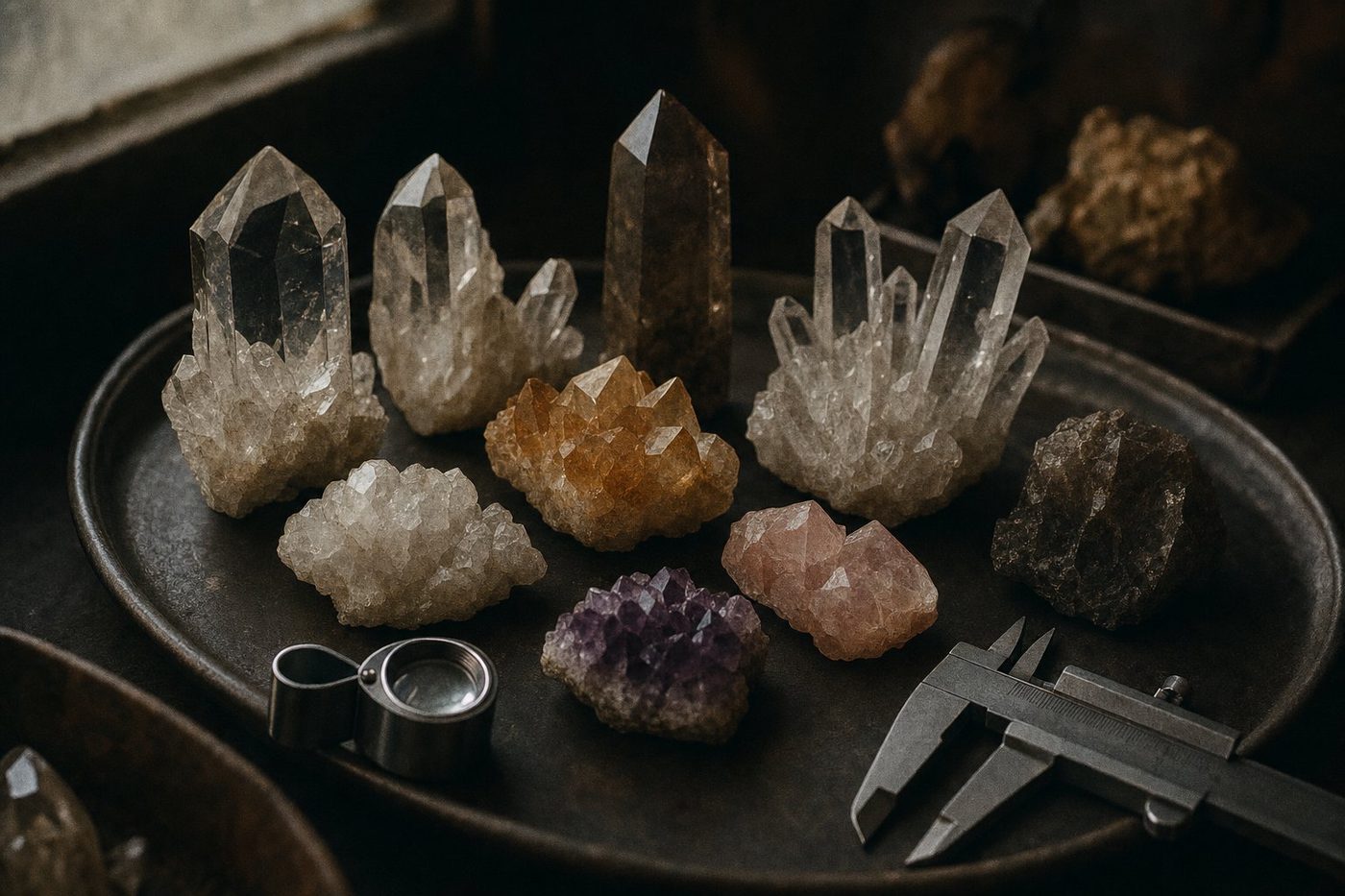
Take an inventory of any practitioner’s shelf and the majority of it will be one mineral. Clear quartz, amethyst, citrine, smoky quartz, rose quartz, carnelian, agate, jasper, chalcedony, onyx, aventurine, tiger’s eye — all silicon dioxide, all the same species, distinguished by trace elements, crystallinity, and inclusion. Correspondence literature treats them as unrelated stones with unrelated properties. Mineralogy treats them as one family with a small number of causes for their differences. The second view is more useful, because it lets you identify what you actually own.
One species, three axes of variation
Quartz is SiO₂, trigonal, Mohs hardness 7, no cleavage, conchoidal fracture, vitreous lustre, specific gravity about 2.65. Every variety on the list above shares that. The differences come down to three things.
Crystallinity. Macrocrystalline quartz forms visible crystals with recognisable prism faces and pointed terminations: clear quartz, amethyst, smoky quartz, citrine. Microcrystalline quartz — chalcedony and its relatives, including carnelian, agate, and jasper — is built of crystals too small to see, which is why it looks waxy or dull rather than glassy and why it breaks in a smoother curve.
Trace elements and colour centres. Amethyst is violet because of iron in the structure combined with natural irradiation. Smoky quartz is brown from aluminium-related colour centres, again with irradiation. Citrine is iron in a different oxidation state. Carnelian is iron oxide dispersed through chalcedony. Rose quartz owes its colour to microscopic mineral inclusions rather than to a colour centre, which is why it is cloudy where amethyst is clear.
Inclusions and structure. Tiger’s eye is quartz that has replaced a fibrous amphibole and inherited its parallel structure. Aventurine is quartzite with mica flakes. Agate is chalcedony deposited in bands.
Colour is the least reliable diagnostic property and the one every buyer uses. Habit, lustre, and fracture are harder to fake and easier to read.
A four-step method
The following can be done on a table with no equipment beyond a steel pick, a piece of unglazed tile, and a torch.
One: hardness, to exclude the impostors
Quartz scratches glass and window glass will not scratch quartz. Test on an inconspicuous surface. This single step removes most of the material that concerns a buyer: dyed calcite, sold widely as banded agate, is hardness 3 and marks with a copper coin. Glass is around 5.5 and takes a scratch from a quartz point. Plastic is obvious once you have handled real material — it is warm to the touch and light in the hand.
Two: lustre and translucency
Under a torch held against the specimen, macrocrystalline quartz transmits light with an internal glassiness; chalcedony transmits with a waxy diffusion. This is the fastest way to sort a bag of unlabelled tumbled stones into the two halves of the family. Look also for a resinous or oily lustre, which usually means the surface has been coated.
Three: habit and fracture
Look for prism faces and a terminated point, or the remains of one. Look at any broken surface: quartz fractures in smooth curved shells, not in flat plates. Flat, step-like breakage means cleavage, and cleavage means the stone is not quartz — calcite, fluorite, and feldspar all cleave and all appear in the trade under quartz-family names.
Four: colour distribution
This is where dyeing is caught. Natural colour in quartz follows the crystal’s growth: amethyst is typically zoned, with colour concentrated toward the terminations and often in angular bands. Dye follows fractures and porosity instead. If the colour sits in the cracks and pools at the surface while the interior is pale, it was applied. Heavily saturated, perfectly even magenta or turquoise in a stone sold as agate is dyed; those colours do not occur in the family.
A related honesty point: most commercial citrine is heat-treated amethyst, and much of it is sold without disclosure. The treatment is not a fraud in itself — it produces real citrine colour in real quartz — but a buyer is entitled to know, and the reddish-orange cast with colour concentrated at the tips is a reasonable indicator.
What this changes in practice
If you use correspondence tables, this method does not ask you to stop. It asks you to know which of your two columns you are reading from. The mineralogical facts are checkable and stable; the correspondences are a cultural tradition, mostly documented in its present form since the late nineteenth century and substantially reworked in the late twentieth. Both can sit on the same page, as they do in our reference entries, provided the page does not blur them.
The practical gain is unglamorous and worth having: you stop paying for dyed calcite, you can tell your students why three violet stones are the same mineral, and you can describe what you own in terms another person can verify.
Sources
For mineralogical data: Deer, Howie and Zussman, An Introduction to the Rock-Forming Minerals, for the silica group; Cornelis Klein and Anthony Philpotts, Earth Materials: Introduction to Mineralogy and Petrology, for structure and optical behaviour; and the Handbook of Mineralogy compiled by Anthony, Bideaux, Bladh and Nichols, which is freely available and gives the standard physical constants for each variety.
For colour causes and treatment: Kurt Nassau’s The Physics and Chemistry of Color remains the clearest account of colour centres in quartz, and his Gemstone Enhancement documents the heat treatment that converts amethyst to citrine. The Gemological Institute of America and the Mineralogical Society of America both publish accessible summaries of quartz varietal nomenclature; mindat.org is a serviceable free index of localities and synonyms, with the usual caution that it is community-maintained.
For the history of the correspondence tradition rather than the mineral: George Frederick Kunz, The Curious Lore of Precious Stones (1913), is the standard early compilation and shows plainly how much of the modern table postdates it.