Who Is the Lenormand Deck Best For? (Hint: Channelers)
You sit down with a deck, shuffle, and pull a card. Before you look at it, you’ve already heard something: a word, a feeling, a flash of an image. Then you turn the card over and it either matches or it doesn’t.
If that sounds familiar, you may not need a bigger deck. You may need a clearer one.
Not Sure Which Deck Fits You?
Your gifts, your learning style and the kind of questions you ask all shape which deck will feel natural. I built a short quiz to help you find out.
Take the quiz: find your deck →
Tarot Is Deep. Lenormand Is Direct.
Tarot is a beautiful system, but it asks a lot of the reader.
It has 78 cards, each with upright and reversed meanings, suits, numbers, elemental correspondences and court-card personalities. On top of all that, the meaning also shifts depending on which cards sit nearby.
That layering is a gift if you love study and symbolism, and if you read exclusively from what you see on the table.
Lenormand works differently. It has 36 cards, and the images are plain: Ship, Key, Dog, Ring, Fox, Mountain. A Key is access, a Fox is someone being cunning. There’s very little to decode.
If you know you’re already sensing something, you just need to put it to words, Lenormand lets the card speak without them getting in the way.
Why That Matters If You’re Clair-Sensitive
If you have clairaudience (hearing), clairvoyance (seeing), clairsentience (feeling) or claircognizance (knowing), the information already comes through you. The cards don’t have to supply the message. They only have to navigate your mind to its form.
Lenormand suits that job for three reasons:
The symbols are literal. If you hear “journey” and the Ship appears, that’s a clean yes. There’s no need to untangle five possible readings first.
The vocabulary is small. With 36 cards and short, concrete meanings, you spend less energy remembering and more energy listening.
The cards work as a guide rail. In a spread, the cards give your channel a structure to move along. They keep you on topic and show you where the message begins and ends.
With tarot, a channeler can end up with a different problem. The intuitive hit says one thing, the textbook meaning says another, and you start arguing with yourself. A simpler deck cuts down on that noise.
Channeling First, Memorizing Second
Many readers feel they’re not a “real” reader until they’ve memorized every card, read reversals, know every spread combo and correspondence. That’s a myth.
If your strength is receiving, the deck can be a tool rather than a curriculum.
Lenormand and other oracle decks let you start reading right away, because the images carry the meaning and your gift does the rest.
You can still go as deep as you like later. You just don’t have to pay such a high overwhelm tax.
A Quick Example
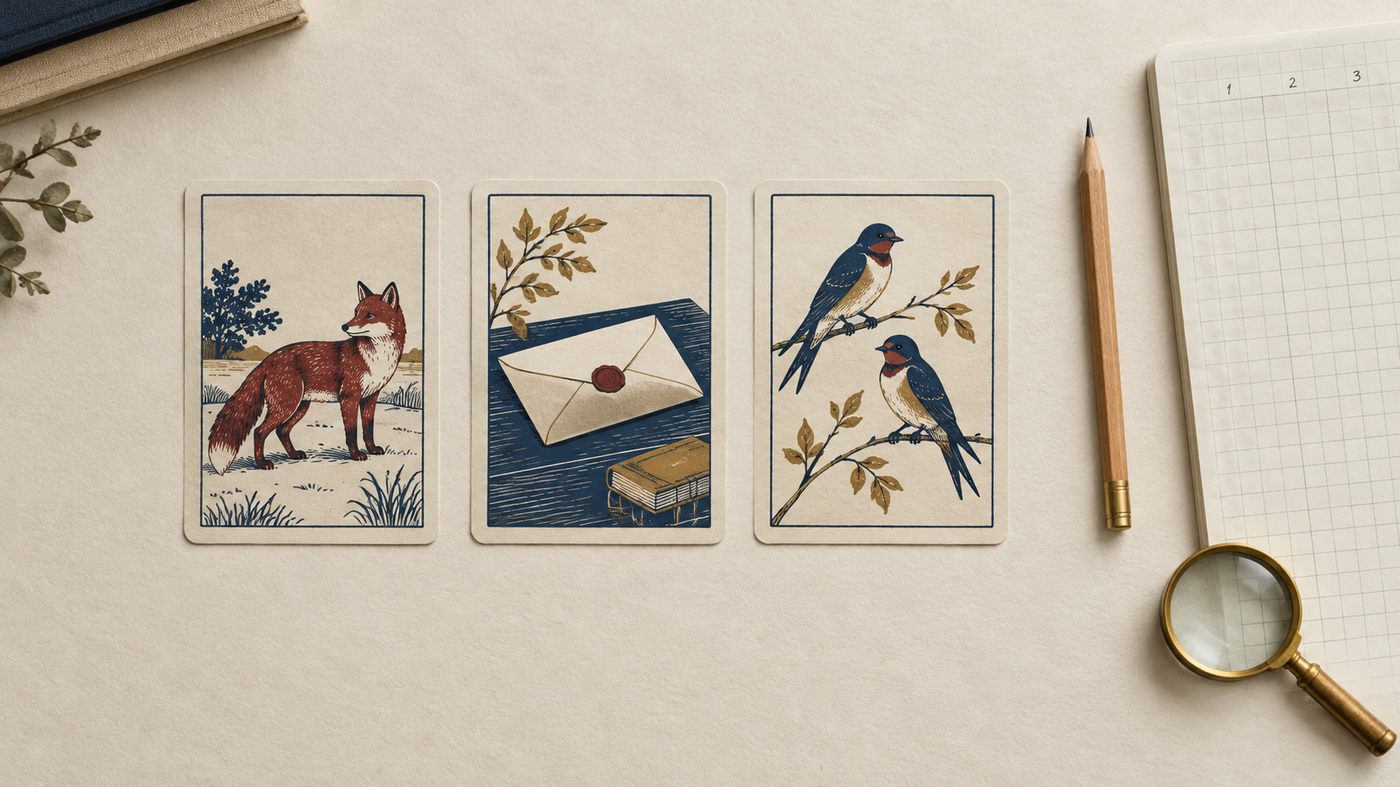
Say you’re asking about a work situation. While shuffling, you clearly hear “someone is not being straight with you.” You pull three cards: Fox, Letter, Bird.
Fox is cunning or self-protection.
Letter is a message or document.
Bird is chatter or nervous talk.
The cards confirm what you heard. They also add the detail that it’s happening through written words and conversation. You didn’t need to remember anything. You only had to listen, and the cards gave you a literal answer.
When Tarot Still Wins
Tarot is still the better choice in a few cases:
- You want psychological depth, reflection and shadow work.
- You enjoy long study and layered symbolism.
- You read for questions about inner growth rather than to read energy around you.
And that’s also why most readers use both! Tarot can explore the “why,” but Lenormand will tell you the “what” and “when.”
Not Sure Which Deck Fits You?
Your gifts, your learning style and the kind of questions you ask all shape which deck will feel natural. I built a short quiz to help you find out.