Reading the Grand Tableau in five passes
Why passes rather than positions
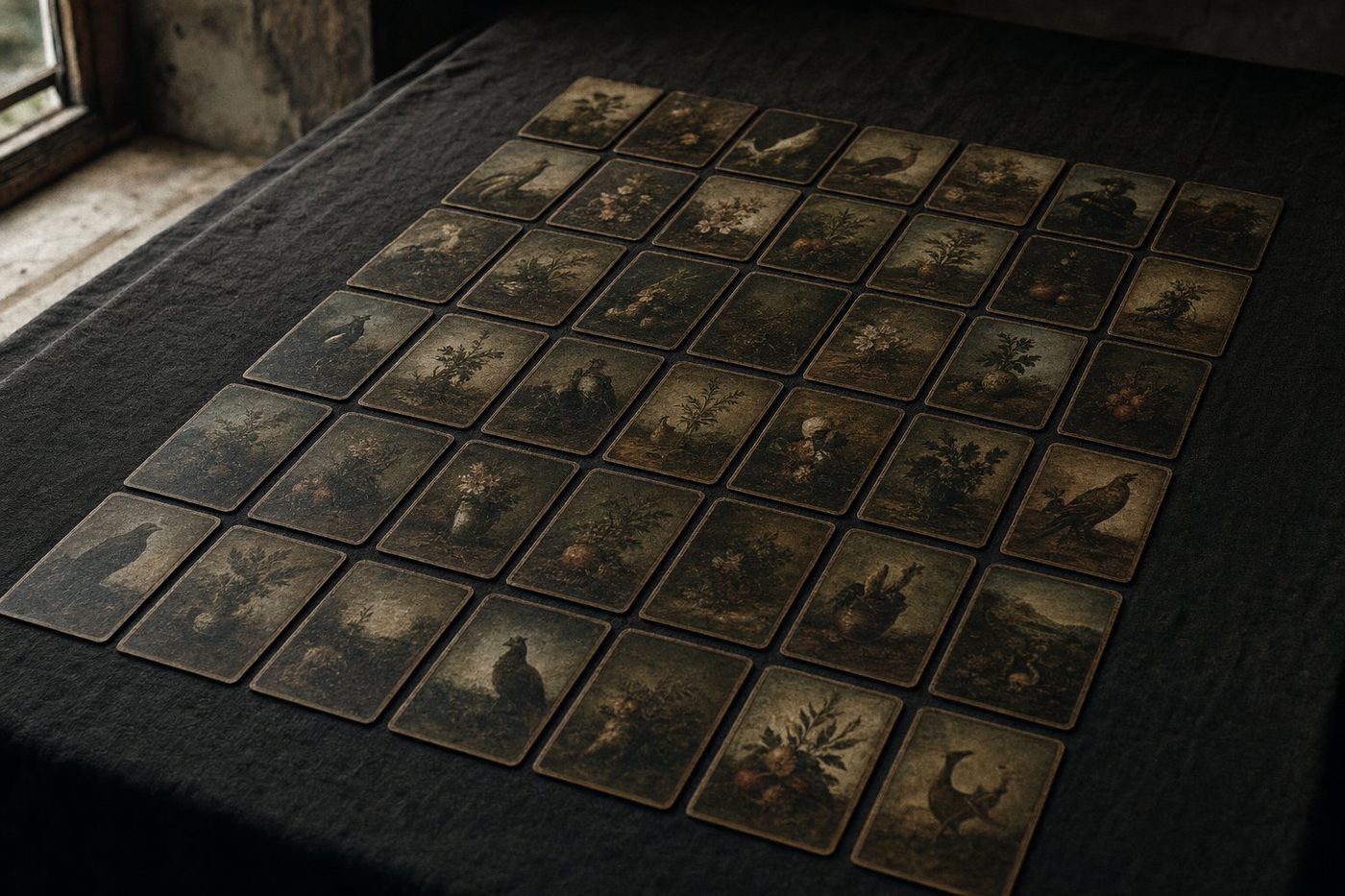
The Grand Tableau fails most readers not because its meanings are hard but because it presents 36 cards simultaneously and offers no order of operations. A tableau read card-by-card produces a list. A tableau read in passes produces a claim.
The procedure below fixes the order. Each pass answers one question, in writing, before the next pass begins. It is slower than intuitive reading and considerably more accurate.
Pass one — locate and orient
Find the significator (28 Man or 29 Woman, or a card nominated in advance). Note its row, its column, and which way it faces. Everything the significator faces is the field it acts upon; everything behind it is the field acting on it. Write down the four cards immediately adjacent and nothing else.
Pass two — read the houses
Every position in the 4×9 layout carries a house meaning derived from the card number that belongs there. The card that lands in house 33 (Key) is the one that resolves the matter; the card in house 36 (Cross) is the one that costs. Record only the houses that hold cards from the significator’s adjacent set — the rest are noise for now.
A tableau does not become readable when you know all 36 meanings. It becomes readable when you decide which eight of them you are going to use.
Pass three — build the lines
Read the significator’s row left to right, then its column top to bottom, then both diagonals. Each is a clause, not a list. Note where a facing direction contradicts the reading order: those contradictions are the tableau’s real content.
Pass four — mirror and knight
Mirroring pairs each card with the one an equal distance on the opposite side of the significator. Knighting jumps in an L-shape, as in chess, and surfaces influences the linear passes miss. Use both sparingly; two mirrors and two knights are enough for most questions.
When to stop
If pass four contradicts pass three, the contradiction is the answer. Do not resolve it by choosing the reading you prefer.
Pass five — state the outcome in one sentence
Close the tableau by writing a single declarative sentence that accounts for the significator’s position, its facing, the house it occupies, and the strongest line. If the sentence needs a conjunction, the reading is not finished.